
Help clarify the issues
The mediator helps participants identify the questions they need to address and explore possible arrangements. The conversation can move through distinct topics without requiring every issue to be settled at once.
About Family Mediator
Family Mediator offers a structured setting for conversations about children, finances and the practical changes that follow separation. The focus is on helping people explore their own options.
The service

Separation can leave several connected decisions unresolved. A question about housing may sit alongside a question about parenting, while financial concerns may affect both. Family Mediator’s services cover child arrangements, financial mediation and divorce mediation.
These services provide a way to discuss issues with an independent mediator. They do not offer a predetermined settlement or promise that everyone will agree. The starting point is understanding what needs attention.
For parents, discussions can include everyday routines, holidays, handovers and how decisions will be communicated. Financial discussions may involve the home, savings, pensions, debts and the information needed to consider possible arrangements.
Divorce mediation brings practical separation issues into a guided conversation. It does not replace the legal process for ending a marriage or the individual advice someone may need about their position.
The mediator’s role

The mediator helps participants identify the questions they need to address and explore possible arrangements. The conversation can move through distinct topics without requiring every issue to be settled at once.
The mediator does not represent either participant or choose an outcome for them. Each person needs space to explain their perspective and consider the options.
Mediation is not individual legal advice. A solicitor or other appropriate adviser can help you understand what a proposed decision would mean for you.
Ways to meet
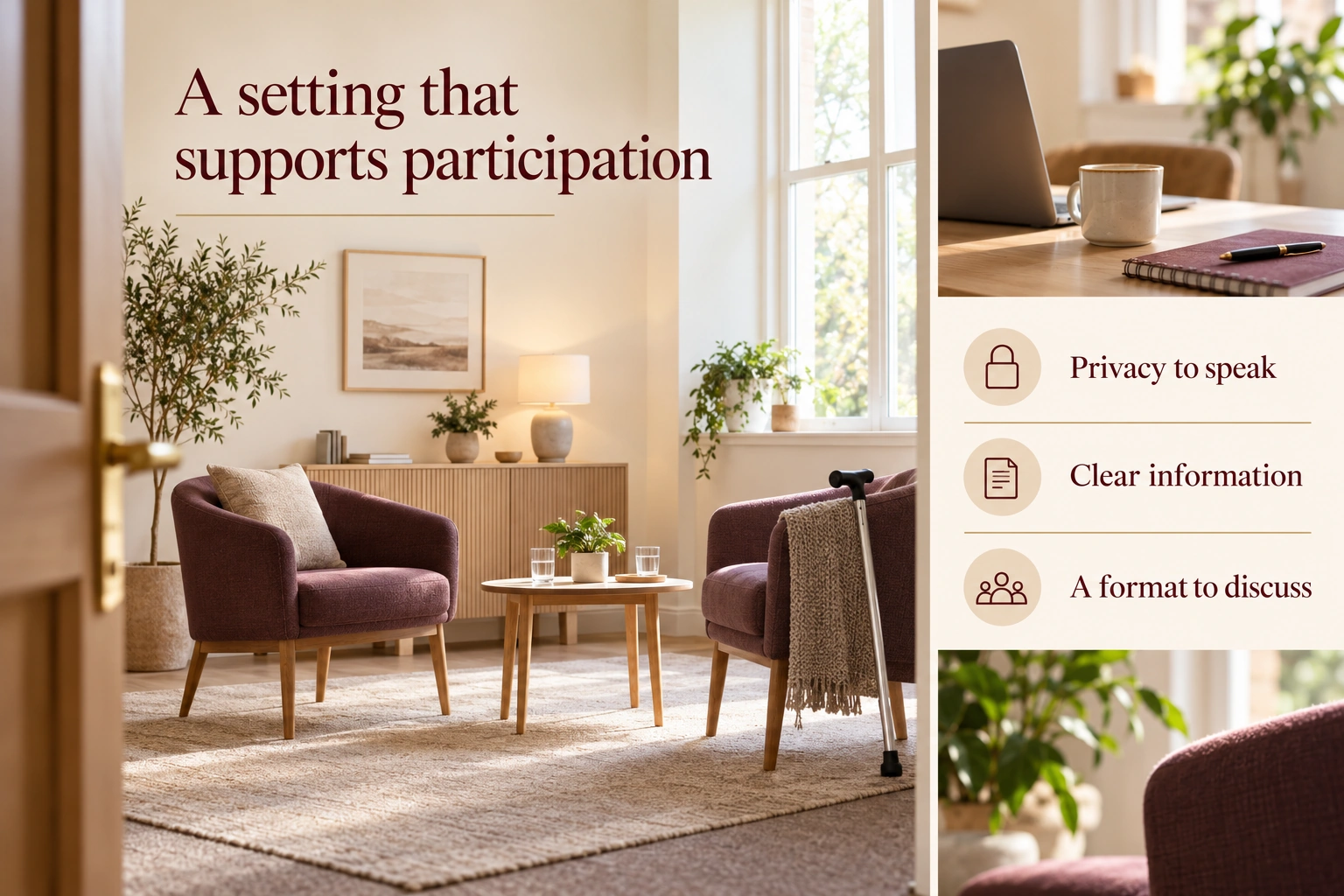
Family Mediator describes online appointments across England and Wales. Meetings take place by video, allowing participants to join from separate locations. A private space and a suitable device and connection are practical considerations to discuss before arranging a session.
Ask which format is available for your circumstances and what joining instructions you would receive. Online access does not remove the need to assess suitability.
In shuttle mediation, participants speak with the mediator separately. The mediator carries the discussion between them, rather than requiring direct conversation in a shared room or online meeting.
This is a format to discuss with the mediator, not a guarantee that mediation can safely proceed. The circumstances of each participant still matter, including any concerns about pressure, intimidation or abuse.
An informed choice
A Mediation Information and Assessment Meeting, often shortened to MIAM, is an opportunity to understand the process and consider whether it is suitable. Finding out about mediation does not commit you to a series of mediation sessions.
Participation in mediation is voluntary. Confidentiality is important, but it has limits, including legal and safeguarding obligations. Ask the mediator to explain those limits before sharing sensitive information.
Where financial proposals are reached through mediation, they are not automatically legally binding. Independent legal advice can help you understand any further steps, including court approval of a consent order where appropriate. Mediation cannot guarantee a particular court outcome.
A considered approach
Family change is rarely only about one practical question. A decision about where a child spends a school holiday may be connected to travel, work, family traditions and the way parents communicate. A conversation about a former family home may involve affordability, housing needs, a mortgage and other financial resources. When several subjects sit together, it can help to identify them clearly before trying to resolve them.
Mediation offers a structured setting for people to explore those subjects. The mediator helps keep a discussion focused and supports participants in hearing what matters to one another. This does not mean every view will be agreed with, or that the mediator will decide which account is correct. The aim is to make the issues and possible options clearer so that the participants can decide what, if anything, they want to do next.
A measured process can also make it easier to separate immediate practical needs from decisions that require more information. Some questions may be answerable now; others may depend on a document, professional advice or a later conversation. Identifying an unanswered question is a useful outcome in itself, even when it does not produce an agreement.
People can arrive with different levels of preparation and different feelings about separation. One person may want to talk quickly, while another may need time to understand the process. The first assessment meeting gives an opportunity to ask questions and consider suitability before deciding whether to continue. It should not be treated as a promise that the service will resolve a dispute or as a commitment to future meetings.
It is also reasonable to ask about what the process cannot do. A mediator does not replace a court, a solicitor, a financial adviser or a therapeutic service. Mediation can help people communicate about decisions; it cannot guarantee that another person will participate, disclose information, accept a proposal or behave in a particular way. A clear explanation of these limits helps people make an informed choice.
That emphasis on clarity is why this website distinguishes an enquiry from an appointment and a MIAM from further mediation. Ask about the details that matter to you, including any boundaries or practical arrangements that would affect your participation.
Children and parenting

When parents separate, children may experience changes to routines, homes, travel, relationships and the way adults communicate. Conversations about child arrangements can consider practical matters such as school weeks, weekends, holidays, handovers and how parents will share information. The topics will depend on the family; a list of examples is not a required agenda and does not imply that every family should make the same arrangement.
Mediation does not ask a child to choose between parents. Adults remain responsible for decisions and for considering a child’s needs. The mediator can help parents discuss what might work in daily life, what information they need and how they will review arrangements as circumstances change. A plan that works for one family may not suit another, and a child’s needs can change over time.
It can help to talk about the ordinary details as well as the headline decision. For instance, parents might need to consider school collection, transport, medicines, activities, family events, notice for changes and what happens if a child is ill. These are examples to help identify questions, not advice about what a particular parenting plan should say. Parents may also want to discuss how to keep the child out of adult disagreements and how to communicate without asking the child to pass messages.
Some families need to discuss how decisions about education, health or travel will be handled. Others may focus first on a reliable weekly routine or a way to share updates. A mediator can help participants break a broad concern into smaller, more manageable topics. If important information is missing, it may be more useful to identify how to obtain it than to make an assumption.
The process is not appropriate in every situation. Concerns about domestic abuse, coercion, intimidation, a child’s safety or an inability to take part freely should be raised privately with the mediator when safe to do so. An assessment should consider whether mediation is suitable, not simply whether a different room or video link can be arranged. If you are worried about immediate harm, contact the relevant emergency or safeguarding service rather than waiting for mediation.
Parents may find it helpful to obtain independent legal advice about their rights, responsibilities and any proposed arrangements. Mediation supports a conversation; it does not determine a court application or provide a guaranteed outcome. Where a child’s welfare or urgent protection is at issue, obtain appropriate professional guidance.
Financial conversations

Financial mediation can provide a setting to identify the decisions people need to make after a relationship ends. Depending on circumstances, subjects may include a home, mortgage, savings, pensions, income, debts and other financial resources. Naming an asset does not establish its value, ownership, tax treatment or legal status. Those details may require disclosure, records and independent professional advice.
Information matters because a proposal can only be considered sensibly when the participants understand the relevant financial picture. Ask the mediator what information is needed, how it should be shared and how questions about missing or unclear details can be raised. Do not send documents through an unverified channel or assume that a general enquiry is the right place to submit confidential records.
Participants may need to consider both immediate practical needs and longer-term consequences. For example, keeping a home may raise questions about mortgage affordability, future costs and whether a lender would agree to a change. A pension may involve specialist valuation or advice. A debt may need clarification about whose name it is in and how repayments are currently made. These examples are prompts for discussion, not recommendations or a financial assessment.
The mediator can help people organise the conversation and identify options for consideration. They do not value property, recommend a division, give a personal investment or tax opinion, or guarantee a lender’s decision. Where expertise is needed, an independent solicitor, accountant, pension specialist or financial adviser may be appropriate.
A proposal reached in discussion is not automatically a legally binding financial order. People may need legal advice and further formal steps, such as asking a court to approve a consent order where appropriate. Whether that step is needed depends on the circumstances. Do not treat a preliminary note, summary or verbal understanding as a substitute for checking the legal effect of an agreement.
It is important that everyone understands the information and has a fair opportunity to consider it. If you are being pressed to agree before you have reviewed relevant figures, ask for time, advice or clarification. You can also ask what the next step would be if participants cannot agree or if additional information is needed.
Financial circumstances may change between discussions. A job change, a move, a new expense or a delay in obtaining information can affect what options are realistic. Participants can ask how the process handles a question that cannot be answered in one meeting. There is no requirement to settle every financial matter in a single conversation.
Speak to an independent adviser about your own position before relying on a proposed financial arrangement. The mediator’s neutral role is distinct from advice tailored to one participant.
Different ways to take part

Online mediation can make it possible for people in different places to meet with a mediator by video. Family Mediator’s service information describes online service across England and Wales. Before agreeing to this format, ask which technology will be used, what device and connection are needed, how joining details will be sent and what support is available if someone has difficulty joining.
A private space can matter, particularly where the discussion involves personal or financial information. Consider who else might be able to hear the conversation, whether notifications could interrupt, and whether you can speak without being observed or pressured. Headphones may help with privacy in some settings, but they do not solve every safety or confidentiality concern.
Participants should ask in advance what happens if the connection fails, whether everyone can access the platform and how documents will be shared if needed. Do not assume that a video call is recorded or that it is not recorded; ask the provider to explain its actual practice before taking part. This website does not operate a video meeting or booking system.
In shuttle mediation, the mediator speaks with each participant separately and carries information between them. This may mean there is no shared conversation between participants. Ask how the format is organised, how messages or proposals are checked for accuracy and whether separate appointments are required.
Shuttle mediation describes a way to conduct discussions; it is not a safety certification or a promise that a case is suitable. A careful individual assessment remains important. A history of abuse, intimidation or control should not be minimised because the participants are physically or virtually separate. If you have a concern, tell the mediator privately when it is safe, and ask how the assessment will address it.
Participants may also ask whether the mediator will relay exact words, a summary or questions, and how each person can correct a misunderstanding. Clear communication about the process can reduce uncertainty. You are not required to accept a format without understanding how it works or whether it feels appropriate for you.
What mediation can and cannot offer
A mediator supports a fair and organised discussion. Their role is different from representing one person, advocating for a preferred settlement or making a binding decision. The mediator can help participants identify topics, ask questions, explore possible options and record what has or has not been agreed, subject to the service arrangements.
Neutrality does not mean that all conduct is acceptable or that safety concerns should be ignored. A mediator should consider whether people can participate freely and whether the process is appropriate. If you feel unable to speak honestly, understand what is being proposed or say no, raise that concern. You can request a private conversation with the mediator if appropriate, and you can decide not to continue.
Mediation is generally voluntary. Court rules about attending a MIAM before certain applications are separate from a general obligation to mediate; exemptions may apply and the exact requirements depend on the case. A general website page cannot determine whether you need a MIAM, whether an exemption applies or what a court will require. Seek qualified legal advice if you are unsure about a court application or deadline.
Confidentiality is important, but it should not be described as absolute. There can be legal, safeguarding or other recognised limits. Ask the mediator to explain what can remain private, what may be shared and how any written record will be handled. Understanding those limits before sharing sensitive information is part of making an informed decision.
People may reach a partial agreement, identify information they still need, decide to pause, or conclude that mediation is not the right route. Those possibilities do not mean the process has failed. They may help clarify what professional advice, formal steps or other support would be useful next.
Independent advice remains available throughout. Participants can ask a solicitor to explain the legal effect of options, or consult another specialist where financial, tax, pension or wellbeing questions arise. A mediator can help identify issues for advice but cannot replace the adviser’s role.
A respectful process
It can help to describe what you have experienced, what matters to you and what question you want to resolve. Clear, specific examples are often easier to discuss than broad labels. You do not have to agree with another person’s account in order to listen to the concern they are raising.
If a subject feels too difficult to discuss in a joint setting, ask whether it can be raised privately or whether another format may be considered. A separate conversation is not an automatic substitute for a suitability assessment.
Sometimes participants arrive with a preferred outcome. It can be useful to distinguish that proposal from the underlying need. A request for a particular handover time, for example, may relate to work, transport or a child’s routine. Understanding the practical reason can help people explore whether other options exist.
This does not oblige anyone to change their position. It creates room to ask what information is missing and what options are workable, without assuming that a compromise is always appropriate.
Important decisions may need more than one discussion. You can ask for time to review information, take independent advice or consider a proposal. If there is a deadline, make that clear and obtain legal guidance about its effect; a mediation appointment does not pause a court timetable.
Before accepting a proposal, make sure you understand it and have had the opportunity to ask questions. If you are uncertain, say so rather than feeling obliged to provide an immediate answer.
Questions people often ask
Mediation is generally a voluntary process. A MIAM requirement may apply before certain family court applications in England and Wales, subject to the rules and any exemption that applies. That is not the same as being required to mediate or reach an agreement. Get advice about your specific application rather than relying on a general description.
The mediator does not decide the dispute or guarantee what a court would do. A solicitor can advise you about your legal position and possible court outcomes. If you need that advice, ask for it independently before making a decision.
The mediator’s role is to facilitate the discussion impartially, not to represent one participant. If you feel that you are not being heard or cannot participate freely, raise the concern. Ask how it will be considered and what alternatives are available.
Not necessarily. The service information describes shuttle and online options, but availability and suitability depend on circumstances. Ask how the meeting would work and whether it addresses your particular concern.
People may leave with no agreement or with some matters unresolved. The mediator can help clarify what was discussed and what other routes participants may consider, within the service’s remit. Independent legal advice can help you understand formal options and any relevant deadlines.
Confidentiality has limits. Ask the mediator to explain the applicable arrangements, including any legal or safeguarding exceptions and how records or summaries may be used. Do not assume that a particular statement will remain undisclosed without checking first.
From questions to options
The examples below illustrate how someone might organise a discussion. They are not accounts of clients, recommendations for a settlement or promises about the result of mediation. Their purpose is to show the difference between naming a concern, checking information and choosing what to do next.
The broad concern might be that arrangements keep changing at short notice. One practical question is who can collect a child on a particular day. Other questions concern the school timetable, travel time and what notice a change requires. Separating these points can make it easier to identify which information is missing.
A discussion could then compare possibilities against the child's ordinary routine and each adult's actual commitments. That does not establish that any particular timetable is fair or appropriate. A parent may need advice about an existing order, and a safety concern may mean that a different route is needed. Neither the example nor mediation itself changes a legal obligation.
The broad concern might be not knowing whether either person could remain in the home. Before deciding between options, the participants may need to understand what figures are available, which questions require a lender's response and whether an independent valuation or legal advice is needed.
An option can be recorded as a question to investigate rather than a promise to carry it out. For example, identifying the need to check affordability is different from confirming that a mortgage change will be approved. The mediator's role in organising the conversation does not make them responsible for the lender's decision.
After considering an issue, distinguish three things: what is understood, what remains uncertain and what needs advice. A note can record the topic, the information to check and the next question. It should not describe an unaccepted option as an agreement.
That distinction also helps when there is only partial progress. Clarifying one practical point does not mean that connected financial or parenting questions have been settled. Participants can recognise the limited progress without extending it beyond what they actually discussed.
If an important condition changes, revisit the assumption behind the option. A work pattern, school arrangement or financial figure may turn out to be different from what was understood. Asking what has changed gives the discussion a specific focus and helps keep a preliminary idea separate from a decision someone is ready to rely on.
Your next step
You can ask about the first meeting, raise a practical concern or clarify which service relates to your situation.